
How Integrated Systems Solve the Mystery of Wasted Marketing Budgets
In my work, I daily encounter managers struggling with the same frustration: "We put so much money into digital marketing, but I don't know exactly what's happening with it." If you have a similar feeling, it’s likely because you’re looking at the problem from the wrong angle.
Most companies "do" marketing. They perceive it as an isolated activity, a separate budget line, essentially as the purchase of advertising. The problem is that today, marketing is no longer about advertising. It is about data. So, let's stop "doing" marketing and start building an intelligent digital ecosystem instead.
I see it as a system of inputs and outputs:
- The Old Model (Advertising): You pay for a banner (input) and hope customers come (output). What happens in between? It’s a black box.
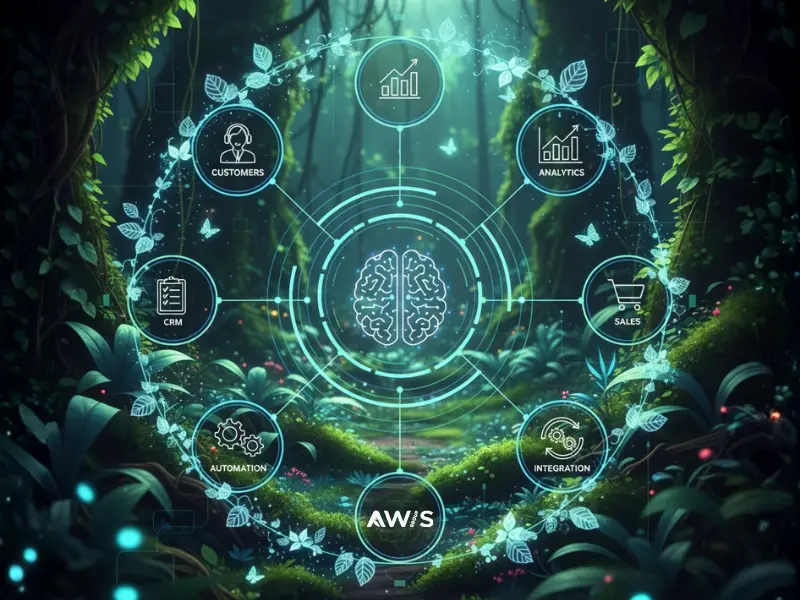
- The New Model (Ecosystem): A customer clicks on targeted content (input). Their activity is immediately recorded in your CRM (Customer Relationship Management). The system evaluates their behavior and categorizes them into a segment. If they show interest, marketing automation sends them a relevant email. If they buy, the order is transferred to the ERP (Enterprise Resource Planning). Your BI (Business Intelligence) tool evaluates the whole process and shows you that this specific customer journey brought you a profit of $X$ with costs of $Y$.
It is a connected data flow. Suddenly, you realize that your CRM is more important than your campaign's creative. Because without customer data, even the most beautiful ad is just a shot in the dark. If your marketing is not directly connected to your CRM and ERP, you are burning money. It’s like writing code without error handling—it looks like it’s running until the whole system crashes under the first sign of load.
Digital Marketing = Ecological Marketing (The Eco-Enthusiast’s View)
Sustainability and ecology aren't just about solar panels and waste sorting. In business, it is primarily about efficiency and not wasting resources. Traditional "spray and pray" marketing (mass targeting of everyone) is a huge waste:
- You waste money (paying to reach irrelevant people).
- You waste computing power and energy (servers showing ads to millions who aren't interested).
When you know who your customer is (thanks to CRM) and what they are interested in (thanks to analytics), you can deliver exactly what they need at the moment they need it. It is surgically precise. You don't reach out to 100,000 people to get 10 customers. You reach out to 100 relevant people and get 20.
I call this "ecological marketing." It is effective, respects resources (yours and the customer’s), and builds a higher-quality relationship because you aren't perceived as spam, but as a helpful partner.
Why Your CTO Must Love Your CMO (The Business View)
In the old model, the IT department (led by the CTO) and the marketing department (led by the CMO) were two separate worlds. Marketing wanted a pretty website; IT talked about security and resources.
Today, this division is dead. Marketing is technology (MarTech). The tools marketing uses—CRM, analytics, automation, content management systems—are now the backbone of a company's revenue.
And here arises a problem we see at AWIS group constantly: You have a top-tier ERP system. You have a modern CRM. But they don't talk to each other.
The result?
- Marketing doesn't know which customers are the most profitable (data is in the ERP).
- Sales doesn't know which clients reacted to the campaign (data is in the marketing tool).
- IT is frustrated because it constantly has to fix connections.
We call these "expensive silos." A true digital ecosystem only emerges when you connect these systems.
Conclusion
Start asking: "How are we investing in our digital ecosystem to make the whole company more efficient—from the first contact to invoicing and service?"
When you change this perspective, everything changes. Marketing transforms from a cost center into a strategic partner for growth, efficiency, and sustainability.